Home / Technology / Biotekna
Biotekna
Get patients in the door. Prove your program works. Keep them for life.
One fifteen minute, non-invasive scan shows a patient how their body is actually functioning and where that is heading. Then it shows them, in numbers, that what you are doing for them is working.
Why it is different
Blood work tells you where a patient is today. This one looks forward.
That gap is the whole opportunity. It gives you something to sell that nobody down the street has, and it gives the patient a reason to come back and see the number move.
What a practice already has
The snapshot
Labs and imaging tell you what is happening right now, and they are very good at it.
What almost nothing does
The trajectory
Measure how the body is functioning, then map where those patterns are trending over the next five years.
Where it reads
Three places on the body. One picture of the system.
Nothing enters the body and nothing is drawn from it. Two readings are optical, one is a low-level current.

HEG
Prefrontal blood flow and oxygenation, read optically. Also delivers neurofeedback training.
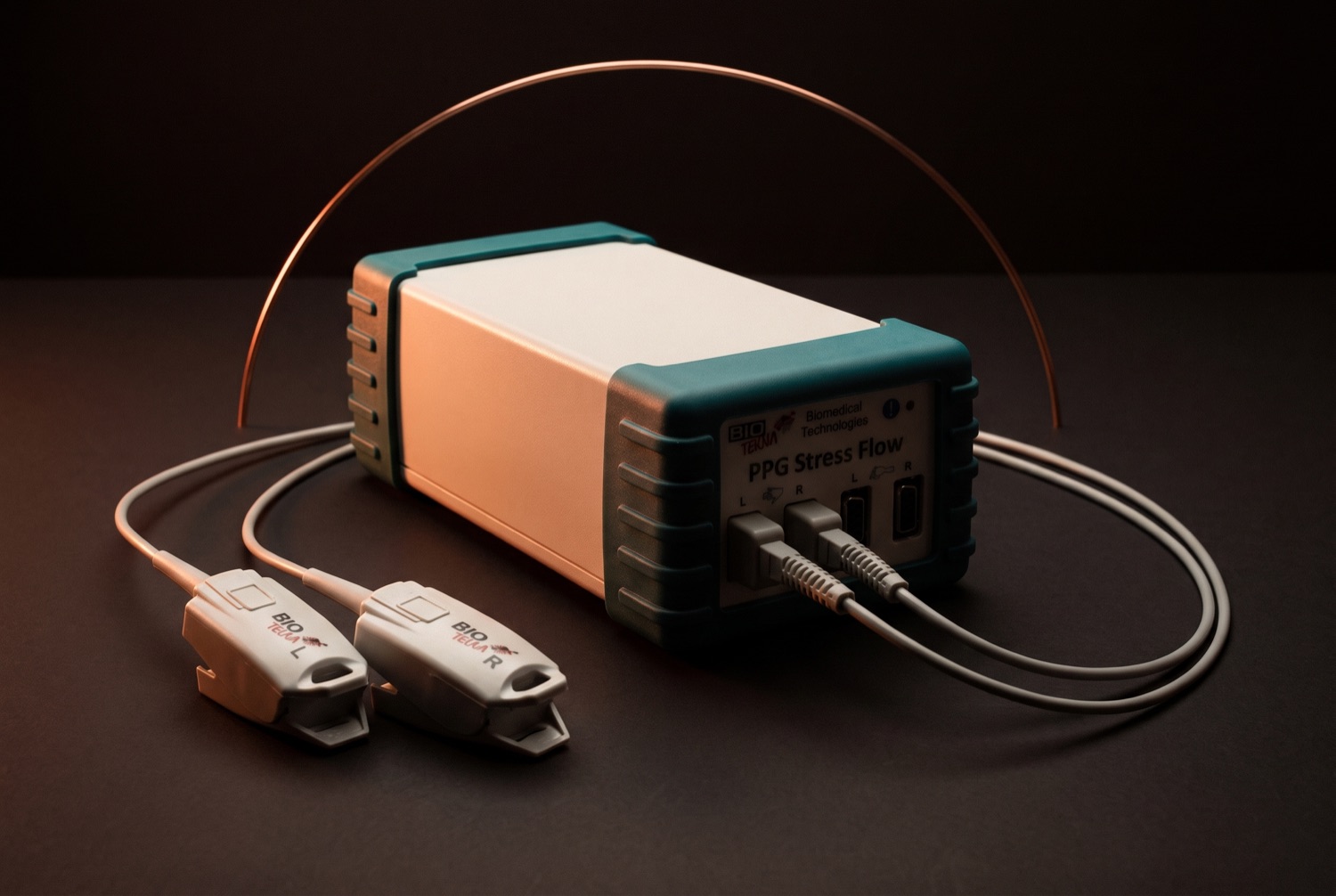
PPG Stress Flow
Autonomic balance, heart rate variability, breathing and peripheral circulation. The same principle as a pulse oximeter.
BIA-ACC
Body composition, hydration and tissue quality, read with a low-level current rather than light.
Select a point to see what it reads
-
Non-invasive
Nothing enters the body and nothing is drawn from it. No needles, no lab send-out.
-
Fifteen minutes
Short enough to run inside an appointment your team is already booking.
-
Objective
Numbers, not how the patient says they feel. The same measure every visit.
-
One report
It lands as something you can put in front of the patient and talk through.
-
Your team can run it
Training on the device and on the conversation that goes with it is part of the deal.
Two ways in
Measure. Or measure and treat.
You are not choosing between six devices. There are two ways in, and everything else is detail underneath one of them.
The first way in
Predictive Health Suite
Measure
Three scans, fifteen minutes, in your own office.
See what it measuresThe second way in
The Complete System
Measure and treat
Everything in the first, plus two in-clinic recovery technologies run back to back.
See the recovery tierThe second stacks on the first rather than replacing it. You do not need it to start.
The core suite
Three scans. Five reports. One picture.
Fifteen minutes, start to finish, in your own office. The composite report is the one that matters most, because it is the one that brings the scans together into something a patient immediately understands.
Scan 01Stress, circulation and nervous system balance
PPG Stress Flow · optical
What it reads. Autonomic nervous system balance, heart rate variability, breathing patterns, peripheral circulation and vascular regulation.
The bonus. The same unit runs guided respiratory biofeedback, which supports stress regulation, autonomic flexibility and recovery. You can watch the numbers respond in the room.
How. The same principle as a pulse oximeter: it reads the pulse at the fingertip and derives the picture from heart rate variability. A clip on the fingers, nothing enters the body.
Scan 02Body composition, inflammation and metabolic resilience
BIA-ACC · electrical
What it reads. Body composition, hydration, cellular and tissue quality and fluid distribution.
And underneath that. It identifies neuroendocrine and metabolic patterns associated with stress adaptation, low-grade inflammation and reduced physiological resilience. This is where a patient gets a number they understand and want to move.
How. A painless multi-frequency current passed through the body, read at contacts on the hands and feet. No needles, no draw, no radiation.
Scan 03Blood flow and oxygen to the brain
HEG · optical
What it reads. Prefrontal blood flow and oxygenation, non-invasively, from a sensor on the forehead.
The bonus. It also delivers neurofeedback training, which supports self-regulation, attention, cognitive performance and neurovascular efficiency. That turns a measurement into a repeatable service.
How. Infrared light at the forehead, read through a strap. The patient sits still.
Report 04The five-year picture
Predictive Health Index
What it does. The software brings all three scans together into one composite and maps a five-year trajectory across five broad categories rather than any named condition.
And it writes the plan. It generates a customized clinical nutrition plan and a physical reconditioning program automatically. Your team can tweak them. Nobody has to build them from scratch.
Fifth report Sheri to confirm the name and what it covers before this goes live.
The full measurement list is available on request. Ask for it here.
See a live scan and a real report, start to finish.
What the patient sees
The number moves. That is the whole business case.
Scan. Run your protocol. Re-scan. The patient watches their own trajectory improve, which is the most persuasive thing that can happen in your office.
Every re-scan is a reason to come back, a conversation about what changed, and objective evidence that the care they are paying for is doing something.
The marker moving is the sale. It is the practice showing a patient, in their own numbers, that what they are paying for is doing something.
Between visits
The ANS Control take-home unit.
Goes home with the patient, paired to an app on their phone.
It prompts them
You set how often. The app asks. The results come back to you.
It sees the real week
A patient can look calm in your office and be a different person at home on a Tuesday night.
It keeps them on the books
Accountability is the honest reason compliance improves. It also makes this a recurring line, not one appointment.
The second suite
Total Recovery. The tier that treats what you just measured.
Two in-clinic technologies, run back to back, twenty minutes each. This stacks on top of Predictive Health rather than replacing it, and you do not need it to start.
01
TomEEx
Prepares the terrain
Supports connective tissue, the extracellular matrix and the body's internal environment, helping create better conditions for recovery, communication and repair.
02
RegMatEx
Recharges the system
Supports the cell's own electrical activity and bioenergetic function, helping restore cellular vitality, resilience and recovery capacity.
Think of it as a pitch before a game. The first session clears the field. The second one recharges the player.
Both are adaptive. The system re-reads hundreds of times through a session and adjusts the protocol to the patient in front of it, so the result does not depend on who is running it.
Who already uses it
Trusted in Formula 1 and Olympic sport.
Everyone selling a scanner in this country leads with the technology. Almost nobody leads with who already trusts it.
-
1996
Founded in Marcon, near Venice, by Dr Dario Boschiero.
-
Clinical use
Three decades of use across European practice, long before it reached the United States.
-
Elite sport
McLaren Technology Group listed under partnerships. Work across Formula 1, MotoGP, WorldSBK, Olympic sports and the Italian national squads.
-
The study
The predictive composite published against a clinically monitored cohort.
This timeline stops at the last point that can be sourced. Anything more recent goes on once the manufacturer confirms it.
McLaren Technology Group
Woking, UK. Listed under partnerships on BioTekna's own site
Formula 1, MotoGP and WorldSBK
Teams and riders across all three series
Benetton Rugby
Italian top-flight professional rugby, named as a scientific partner
Italian national squads
Track and field, women's artistic gymnastics, fencing and skiing
The extra ten percent is the ability to adapt.
Dario Boschiero, BioTekna founder
BioTekna has published a case study on MotoGP rider Andrea Dovizioso, on their own site. A published case study is not an endorsement, and I will not present it as one.
The patient you already sell to
Family history, a bad lab, a birthday that landed hard. They want to know what is coming, and prevention language lands on them.
The one you currently have nothing for
The founder, the surgeon, the competitive amateur. Nothing is wrong with them, so a risk score does not move them. Same scan, same forty minutes, framed as performance instead of prevention. You already own the hardware to serve them.
Straight answers
The four things every practice asks.
01Is it safe?
Nothing enters the body. No needle, no blood draw, no radiation, no contrast. A sensor at the forehead, a clip at the fingers, contacts at the hands and feet. The patient sits still and the device measures.
02Does it work?
The platform has been in clinical use in Europe for around thirty years, and the measurements themselves are established physiology rather than anything novel. What is new is combining them and following the outcome.
The predictive composite was built against a cohort of 35,000+ people clinically monitored over five years, and there is a substantial body of peer-reviewed work behind the individual measures. I will send you the published study so you can read it yourself rather than take my word for it.
Request the published study→03Is it easy to incorporate?
This is the part most companies skip and the part I care most about. Anyone in your office can run the scans once trained. The machine does the work and adapts on its own, so results do not vary by who is holding it. Fifteen minutes for the full set.
Training comes one to one from the manufacturer's own physicians, not a portal and a webinar. In this industry that is close to unheard of, and it is a large part of why I took the line on.
04Can I make money with it?
It gives you a program to sell instead of an appointment to book. That is the difference. The scan opens the conversation, the report tells you what to treat, and the re-scan proves the treatment worked, which is what makes a patient stay.
It also validates everything else in your building. Whatever protocols, peptides or equipment you already run, this measures whether they moved the number. Ask me for a custom ROI built on your own patient volume and pricing.
Get a custom ROI for your practice→What comes with it from me
The device is the easy part. Selling it is not.
Buying this from me is not the same as buying it from a rep. The technology arrives with the business build around it, because a scanner nobody knows how to position is just another box in a room.
Positioning
- Who this is for in your patient base
- How to price and package it
- Where it sits on your menu
The conversation
- How your team presents the scan
- How to walk a patient through the report
- How to convert a scan into a program
The launch
- Launch offers and introductory pricing
- Events run with you, in your space
- Marketing to your existing list
Ongoing
- Folding it into protocols you already run
- Re-scan cadence and retention
- Advising as the practice grows
Who trains your team
Trained by the physicians who built it. Not by a rep.
No device company does it this way. Thrive Medical Consulting works in partnership with the Biotekna physicians, and the training comes from them.
The training comes from the physicians who built it
PhDs and clinicians, in Europe and in the United States. The neuroscientist often runs these sessions himself. Not a rep with a slide deck.
Then Thrive builds it into your practice
No two practices run it the same way, and the integration is where it either earns or sits in a corner. That part is mine, and it is the half that decides whether the technology pays for itself.
The two numbers that run your practice
Most reps show you what a machine costs. Run your own numbers instead.
Lifetime value is what one patient is worth to you over a year. Acquisition cost is what you spend to get that patient through the door. Everything else is downstream of those two.
Your practice
Whatever you decide it is worth. This is your number, not a suggested price.
Start conservative. This is your first ninety days, not year three.
Your program or membership value, not the scan. This is the number that actually moves.
One in five is the number to argue with. Change it.
If you do not know this number, that is the finding.
You are setting this, not me. Drag it to whatever you would actually believe.
Lever one · revenue
—
Added annual revenue
- Scan revenue
- —
- Program revenue
- —
The scan is not the revenue. The scan is what makes the program an easy yes.
Lever two · acquisition
—
Modelled annual saving
- Acquisition spend today
- —
- Effective cost per patient
- —
Most practices cannot answer this. That is usually where the money is going.
Both levers, on your numbers. —
These are your numbers, entered by you. This is a model, not a projection and not a guarantee of results.
Your return does not matter if it costs you more to get a patient than you make from one. Both of those numbers move. Most people only ever watch one.
Per scan
The simplest way in, and the one the calculator above models. A line on the menu at whatever you decide it is worth.
Inside a membership
A monthly membership with a scan included. If you do not run memberships yet, this is a reason to start one, and the re-scan is what makes it renew.
As a new tier
If you already run tiers, it either lifts an existing one or becomes the tier above it. Longevity practices tend to take this route.
- 01
Scan. The patient gets a baseline they understand.
- 02
Run your protocol. The program is yours, not the device's.
- 03
Re-scan. The change is visible rather than asserted.
- 04
They book the next block, because the number moved.
This is the part a device rep never talks to you about, because they are selling you a machine. Nothing on this page tells you what the device costs. That is on purpose.
Provenance
Where this comes from.
30yrs
In clinical use in Europe
35,000+
People monitored over five years
CE
Marked. Made in Italy. FDA registered
1:1
Training from the manufacturer's physicians
The published study
Read it yourself. Do not take my word for it.
The predictive composite was built against a cohort of 35,000+ people clinically monitored over five years. I would rather you read the paper than listen to me characterise it.
I ask for your practice details because I only send this to people actually working in a practice, and because I would rather know who I am talking to before I follow up.
On its way
Check your email.
The study is coming to the address you gave me. If it has not landed in a few minutes, look in spam, then call me on 407.781.6217 and I will send it directly.
Book a 20 minute walkthrough. See a live scan and a real report.
Ask for a custom ROI built on your own patient volume while you are there. It is a conversation, not a pitch.